Agencies
Clients can bring the media buying in house. Not the reason their customers buy.
Your DSP seat and the client’s platforms report who saw the work and who clicked. stage gives your planners and strategists a behavioral read on each client’s market from 17,000+ signals, with every client walled off from the rest and lift reported under your agency’s name.
The decisionWhich agency a client keeps, and why it renews.
01Pressures
What agency leaders are up against
Reviews, transparency and automation all squeeze the same thing: what a client will pay an outside agency to do.
-
Every account is up for review
Clients call reviews more often, and procurement runs them on fee and scope. Pitching eats unbilled months, and even an incumbent that keeps the business often keeps it at a lower fee.
85%
Of U.S. B2C marketing executives plan to review their media agencies in 2026.Source: Forrester, Predictions 2026: Marketing Agencies (Jay Pattisall), October 1, 2025. Stated intent for 2026. -
Principal media pays, and clients want to see the math
Margin increasingly comes from inventory the agency resells, not from fees. Clients are buying more of it and trusting it less, and contracts now ask whether you act as agent or principal.
90%
Of marketers name uncertainty over whether recommended principal media is in their best interest as their top concern, up from 79% in 2024.Source: ANA, The Continued Acceleration of Principal Media (and the importance of proper governance), March 19, 2026. Survey of 114 ANA client-side marketers, October 2025 to January 2026. -
AI is rewriting the scope of work
Advantage+, Performance Max and AI Max now pick audiences and build creative, and procurement expects billable hours to fall with them. The fee has to rest on a read of the customer no platform produces.
02Blind spot
Every rival shop sees what you see.
What your data shows
The DSP seat
Reach, frequency and clicks, the same as every agency on the same platform.
Syndicated segments
The same off-the-shelf audiences your rivals pitch.
The client’s platforms
Their analytics and CRM, when they choose to share them.
What it can’t show
Why the client’s customers buy
And which message each group answers to.
A data-science bench
Most pods don’t have one, and can’t bill for one.
Proof a finance team accepts
Incremental outcomes against a holdout, not attributed clicks.
What Moonbrush adds
stage is a behavioral intelligence workspace for planners. Explore a client’s market in plain English, build cohorts on motivation and decision style, brief creative by cohort, activate, and read lift against a holdout. Every client lives in its own workspace.
03Decision
The account cycle, with a reason at every step
Where stage sits, from the first pitch to the renewal.
-
01
The pitch
You have days, and none of the prospect’s data.
We read
The prospect’s in-market pool, sized from a plain-English brief.
You can
Walk in knowing why their customers buy.
-
02
The plan
Every rival is proposing the same segments.
We read
Cohorts by motivation, objection and decision style.
You can
Give every line of the media plan a reason.
-
03
The brief
Creative needs more than a demographic.
We read
What each cohort wants, and what holds it back.
You can
Give the brief a creative angle per cohort.
-
04
The flight
Spend goes live across channels.
We read
Who acted, and who in the holdout acted anyway.
You can
Shift weight toward the cohorts that are moving.
-
05
The renewal
Procurement asks what the fee bought.
We read
Lift against the holdout, in outcomes finance recognizes.
You can
Renew on proof, under your name.
04Calendar
When agency decisions get made
The agency year runs on client budget cycles, the upfront market and procurement’s calendar, not on the campaign calendar.
January to February
Retainers reset
New scopes of work and fees take effect for calendar-year clients, Q1 budgets release and the first flights get briefed.
With MoonbrushAgree each client’s holdout design before the first flight, so every read that year comes back in the same format and adds up at renewal.
March to May
July fiscal years
Clients whose fiscal year starts in July, common among packaged-goods and tech advertisers, set budgets and agency scope in spring.
With MoonbrushBring a sized read of the client’s market into the budget discussion, so the plan argues for audiences by size and motivation, not last year’s split.
May to July
Upfronts
Networks and streamers present in May, then agencies negotiate volume, CPMs and the audience each deal is measured against, for a season that starts in the fall.
With MoonbrushSize the client’s likely buyers inside the demo the deal is measured against, so the team knows how much of the commitment reaches people in market.
August to October
Annual planning
Calendar-year clients set next year’s budget, channel mix and agency roster, and the agency’s plan gets built against it.
With MoonbrushWrite a holdout test into each line of next year’s plan, so the budget the client approves already says how each line will be judged.
October to December
Scopes and fees
Procurement negotiates next year’s scope, staffing plan and fee, usually priced per FTE, with the incumbent’s results on the table.
With MoonbrushBring the year’s holdout reads to the negotiation, and write audience strategy and lift measurement into the new scope as named deliverables.
November to December
Q4 peak
The year’s heaviest flights run through Black Friday, Cyber Monday and the holidays, alongside open enrollment for health plan clients.
With MoonbrushUse receptivity scores to time the heaviest weeks for each cohort, and keep a holdout so the season’s lift is measured, not inferred from last-click.
05Cohorts
One client segment. Three reasons to buy.
A home-fitness brand’s “active adults, 25 to 44” is one audience in the DSP. Read by motivation, it needs three different briefs.
-
Routine builders
Want a habit that survives a busy week.
- What holds them back
- Have quit programs before.
- What they answer to
- Ten-minute sessions, and streaks.
-
Goal chasers
Training for something with a date on it.
- What holds them back
- Doubt home gear can get them there.
- What they answer to
- Performance proof, and a plan to the date.
-
Gym leavers
Cancelled a membership and want the money back.
- What holds them back
- Worry they won’t use it.
- What they answer to
- The cost math, and a trial.
Illustrative cohorts, shaped like the splits we return.
06Lessons
What we’ve learned in this market.
-
Clients keep in-housing the execution.
Most large advertisers now run an in-house agency. What they still pay an agency for is judgment they can’t easily staff: a read on customers their own seat can’t give.
82%
Of ANA member companies have an in-house agency.Source: ANA, The Continued Rise of the In-House Agency, 2023 edition. -
Parity gets priced as a commodity.
Same DSP seat, same syndicated segments, same plan. When the inputs match, procurement compares the fee. A different read on the customer is the one input a rival can’t copy.
-
Proof travels further than reach.
A lift read against a holdout is the number a client’s finance team repeats in the budget meeting. Reported under your name, it can become the reason you’re renewed.
07Plays
Three places to prove it first.
Each is scoped to one decision, measured against a holdout you choose and read out on day 60.
Usually through
-
Win the pitch with their customers
Size the prospect’s in-market pool from a plain-English brief and split it by why they’d buy, before you hold their data.
What you getA sized, segmented read on the prospect’s market for the pitch deck.
-
Put a reason behind every flight
Give every cohort a motivation, an objection and a creative angle, ready to drop into the media plan and the creative brief.
What you getCohort cards with a motivation, an objection and a creative angle for each flight.
-
Report lift and price on it
Hold out part of every cohort and show the client’s finance team the outcomes the work added, under your agency’s name.
What you getA holdout read in your agency’s name, client by client.
In the workspace.
Every client walled offEach client’s files, audiences and results stay inside its own workspace.
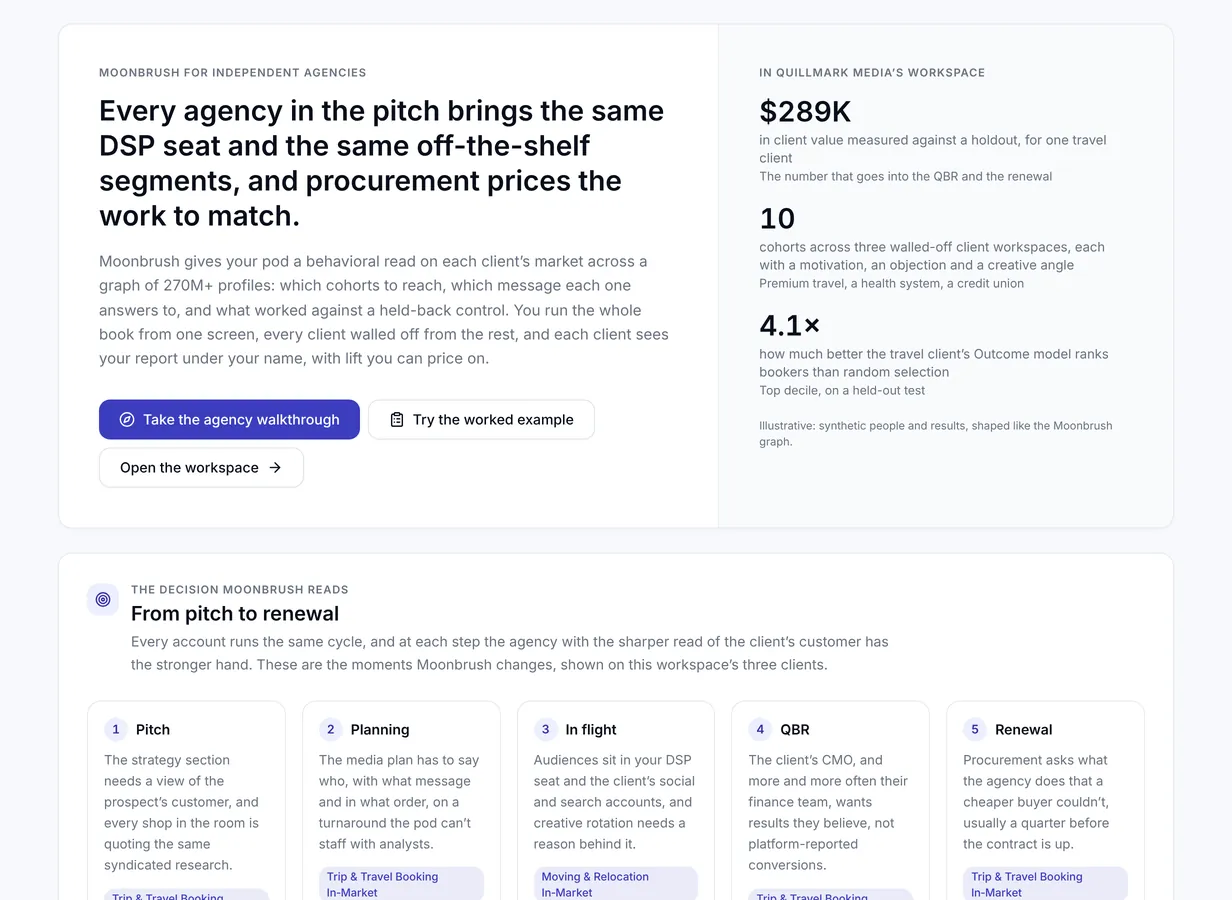
Demo workspace with synthetic people and results, shaped like the Moonbrush graph.
08Metrics
The numbers an agency gets judged on
What agency leaders report to the holding company, the partners or the board, and what stage changes about each.
-
Organic growth
Growth in net revenue, meaning revenue less pass-through costs, from existing clients and new wins. Acquisitions and currency are stripped out.
With MoonbrushAdds scope a pod can bill: audience strategy, cohort briefs and a holdout read on every flight, run by planners rather than a data-science hire.
-
New-business win rate
Pitches won as a share of pitches entered, usually reported alongside net new billings.
With MoonbrushPitches lead with a behavioral read of the prospect’s market instead of syndicated segments. Track win rate on those pitches separately, so the difference is measured rather than assumed.
-
Client retention
The share of last year’s client revenue still on the books, and how many reviews the incumbent survives.
With MoonbrushHoldout reads on every flight show which accounts are delivering before procurement asks, so account leads can fix a weak plan while there’s still time.
-
Billable utilization
Billable hours as a share of hours worked, by person and by pod. Under per-FTE fees, it decides whether a retainer makes money.
With MoonbrushPlanners size and build audiences in plain English instead of waiting in an analytics queue, so senior hours go to strategy the client pays for.
-
Incremental ROAS
Revenue the media added beyond what would have happened anyway, per dollar spent. Client finance teams ask for it in place of platform-reported ROAS.
With MoonbrushEvery flight keeps a holdout, so incremental return is read against the holdout, not taken from the platform’s own attribution.
09Proof
How you’ll know it worked.
What we measureNew-business win rate and client renewals, backed by lift against a holdout.
The first 60 days
- Week 0
Agree on the decision, the data and the success criteria. Paperwork includes the data use agreement and the acceptance criteria.
- Weeks 1–2
Match keys and attach scores in the clean room or your warehouse. Your match rate is reported before anything is built.
- Weeks 3–8
Activate in your channels against a holdout you choose. Outcomes return as they happen.
- Day 60
Read-out on lift and impact, with the validation report. Then an annual program, if the numbers earn it.
10Questions
What agency leaders ask us first
-
How is this different from the third-party segments already sitting in our DSP?
Marketplace segments are built once and sold to everyone on the platform. stage builds each audience from your brief, out of what people actually research and buy, and splits it by why they’d act.
-
We have competing clients in the same category. How do you keep them apart?
Each client gets its own workspace, and its files, audiences, models and results never inform another client’s work, including a competitor’s. Client data is never pooled and never trains models shared with other clients.
-
Our clients already run MMM and platform lift studies. Why do they need another read?
A platform lift study grades that platform’s own delivery, and MMM reads by channel, after the fact. A holdout from each cohort shows, flight by flight, whether the work changed behavior.
-
What do we need from the client, and how soon do we see something?
For a pitch, nothing: the prospect’s market is sized from a plain-English brief. After that, each engagement starts as a 60-day proof on the client’s data, against a holdout the client chooses.
11Rules
The rules that shape agency targeting
An agency inherits every client’s regulatory exposure, so one pod can be working under four rulebooks in the same week.
CCPA/CPRA and state privacy laws
California treats cross-context behavioral advertising as “sharing,” and most state laws let people opt out of targeted ads. Moonbrush honors Global Privacy Control and keeps each client’s data in its own instance.
HIPAA and state health data laws
Marketing with PHI needs patient authorization under HIPAA, and Washington’s My Health My Data Act requires consent to collect or share consumer health data. No PHI is ingested, and health work follows our direct-client rules.
Fair Housing Act, ECOA and Title VII
Housing, job and credit ads can’t exclude protected classes, and Meta’s special ad categories drop age, gender, ZIP code and lookalike targeting. Scores never drive eligibility, and modeled ethnicity is never selectable.
COPPA and state teen privacy laws
The amended COPPA rule requires separate parental consent before a child’s data is disclosed for targeted ads, and a growing number of states restrict targeting teens. Moonbrush holds no data about minors.
The lines we don’t cross here
Every client is an island: its files, audiences, models and results stay in its own workspace and never inform another client’s work.
Health, finance and other sensitive categories run under the same rules as our direct clients.
Modeled ethnicity and political ideology are never selectable, for any client.