Pharma and health
Every prescription is decided twice: once by the patient, once by the prescriber.
Your deciles rank prescribers by volume, and your DTC data shows who reached the savings page. Neither says why either side moves, or when. Moonbrush reads the research, caregiving and evidence habits behind both decisions, with no health record anywhere in the model.
The decisionWhether a treatment gets started, and who has to say yes.
01Pressures
What pharma and health marketers are up against
Closer scrutiny of what you say, more friction between the script and the fill, and fewer open doors to the prescriber.
-
Every ad gets a second look
FDA has sent letters over drug ads by the thousands, and a rule to end adequate provision for broadcast is on its agenda. Every claim, placement and dollar now has to defend itself.
~100
Cease-and-desist letters FDA sent drugmakers over deceptive ads in September 2025, alongside thousands of letters telling companies to pull misleading ads.Source: U.S. Food and Drug Administration, FDA Launches Crackdown on Deceptive Drug Advertising, press release, September 9, 2025. -
The script isn’t the start
Benefits verification, prior authorization, step edits and copay accumulators sit between the prescription and the first fill. Physicians say patients give up when coverage gets hard.
79%
Of physicians report that patients abandon treatment because of prior authorization.Source: American Medical Association, 2025 AMA Prior Authorization Physician Survey, press release, May 13, 2026. Survey of 1,000 practicing physicians. -
Fewer doors, more proof
Fewer offices see reps, the ones that do see fewer companies, and HCP inboxes are crowded. Finance wants incremental scripts, not reach, before the next budget moves.
02Blind spot
Your data counts the scripts. It can’t say why they were written.
What your data shows
NPI lists and deciles
Who writes in the category, and how much.
Claims-based targeting
Where the diagnosed patients are, in aggregate.
DTC site and savings-card data
Who reached the copay page, and who redeemed.
What it can’t show
Why a decile moves
New evidence, the formulary or the patient in the room.
When a conversation is opening
The weeks of research before the appointment, often done by a caregiver.
Who is stuck on coverage
The prior authorization and copay questions that stall a first fill.
What Moonbrush adds
Moonbrush appends a behavioral read to the lists you already run. Prescribers come back split by how they decide, and treatment research and caregiving behavior are read daily across 270M+ U.S. adults, so every segment arrives with the message it answers to.
03Decision
How a start actually happens
Five moments between the first search and a verified start. Each turns on a different question and answers to a different message.
-
01
Something changes
A symptom, a diagnosis in the family, a treatment that stopped working. The research starts, often with a caregiver.
We read
Condition-area and caregiving research, never a diagnosis.
You can
Reach early researchers with unbranded education.
-
02
Weighing options
Treatment-option and second-opinion research, weeks before the appointment.
We read
Treatment-option, specialist and second-opinion research.
You can
Deliver a discussion guide before the visit, not after it.
-
03
The appointment
The prescriber decides on the evidence, on the pathway or with the patient.
We read
Each prescriber’s decision style, appended to your NPI list.
You can
Match HCP messages to how each prescriber decides.
-
04
The first fill
Benefits verification, prior authorization, step therapy and copay. Many starts stall here.
We read
Insurance, cost and copay research by patients and caregivers.
You can
Offer copay support and hub enrollment while they can still help.
-
05
The verified start
The hub or specialty pharmacy confirms the start.
We read
Starts returned hashed and read in aggregate.
You can
Read lift on verified starts against the holdout.
04Calendar
When decisions concentrate in the pharma year
Coverage resets in January, evidence moves at the congresses, and next year’s plan and formulary are set over the summer.
January and February
The January reset
Deductibles reset, new formularies take effect, and patients on new plans start prior authorization over. New starts and refills stall while coverage is sorted out.
With MoonbrushRead coverage and copay research by patients and caregivers through the first weeks, and put savings and hub support in front of them while it still helps.
April to June
Congress season
AACR, ASCO and ADA bring the spring’s major readouts, with ESMO and ASH to come in the fall. Evidence-first prescribers update what they treat as standard.
With MoonbrushSize and brief the evidence-first cohort before the meeting, so the MLR-approved data story reaches them in the weeks after the readout, not months later.
June to September
Brand planning
Next year’s brand plan gets written: segmentation, targeting, channel mix and agency briefs, with budgets set in the fall.
With MoonbrushRun the 60-day proof over the summer, so a result against a holdout is in hand when segmentation and mix are decided.
July to September
Formulary exclusions
The big PBMs publish next year’s formulary changes and exclusions, effective in January. Access teams learn where the brand is preferred, covered or out.
With MoonbrushPlan the access story by cohort: pathway-bound prescribers hear the coverage news first, and caregivers get copay answers before the January reset.
Mid-October to early December
Medicare open enrollment
People on Medicare choose next year’s drug plan, often with an adult child doing the comparing. The plan they pick sets their formulary and out-of-pocket cost.
With MoonbrushRead caregivers researching drug coverage daily, so formulary and access information reaches them while they compare, then read January starts against a holdout.
05Cohorts
Same decile. Three different reasons to write.
Three prescribers can write the same volume and answer to completely different messages. This is how one decile splits.
-
Evidence-first
Moves on new data: trial readouts, guidelines, congress.
- What holds them back
- Waits for the next readout.
- What they answer to
- The data, and where it changes practice.
-
Pathway-bound
Prescribes inside the health system’s pathway and formulary.
- What holds them back
- The pathway hasn’t been updated.
- What they answer to
- Access, coverage and the pathway position.
-
Delegating
Shares the decision with the patient or the care team.
- What holds them back
- The patient hasn’t asked.
- What they answer to
- Patient-side tools, and materials for the care team.
Illustrative cohorts, shaped like the splits we return.
06Lessons
What we’ve learned in this market.
-
Volume isn’t receptivity.
The prescribers who write the most are usually the most contacted. Whether one more contact moves them depends on how they decide, and deciles don’t record that.
-
Caregivers often decide first.
An adult child or a spouse frequently does the research, the comparing and the coverage calls. Their behavior is an early, clear signal, and reading it never requires a health record.
-
The hesitation is often about identity, not the product.
Mothers of student-athletes saw MinuteClinic as cheap, and choosing it felt like a statement about them. Rebuilt around what each cohort admired, the work moved branded search.
+37% branded search in eight weeksCVS MinuteClinic: The Sideline Standard
07Plays
Three places to prove it first.
Each is scoped to one decision, measured against a holdout you choose and read out on day 60.
Usually through
-
Give every decile a reason
Match your NPI list as delivered and split prescribers into evidence-first, pathway-bound and delegating cohorts, appended beside the tiers you already run.
What you getCohort labels and message hypotheses beside your existing tiers, ready for MLR review.
-
Meet treatment research as it opens
Read treatment-option, second-opinion and caregiving research daily, so early researchers get the discussion guide and caregivers sorting out coverage get copay support.
What you getAudiences of early researchers and caregivers, refreshed daily and activated hashed in your channels.
-
Prove the launch wave on starts
Hold out part of every launch target list, return verified hub starts hashed, and read lift in aggregate against the holdout.
What you getA holdout design, and a lift read on verified starts.
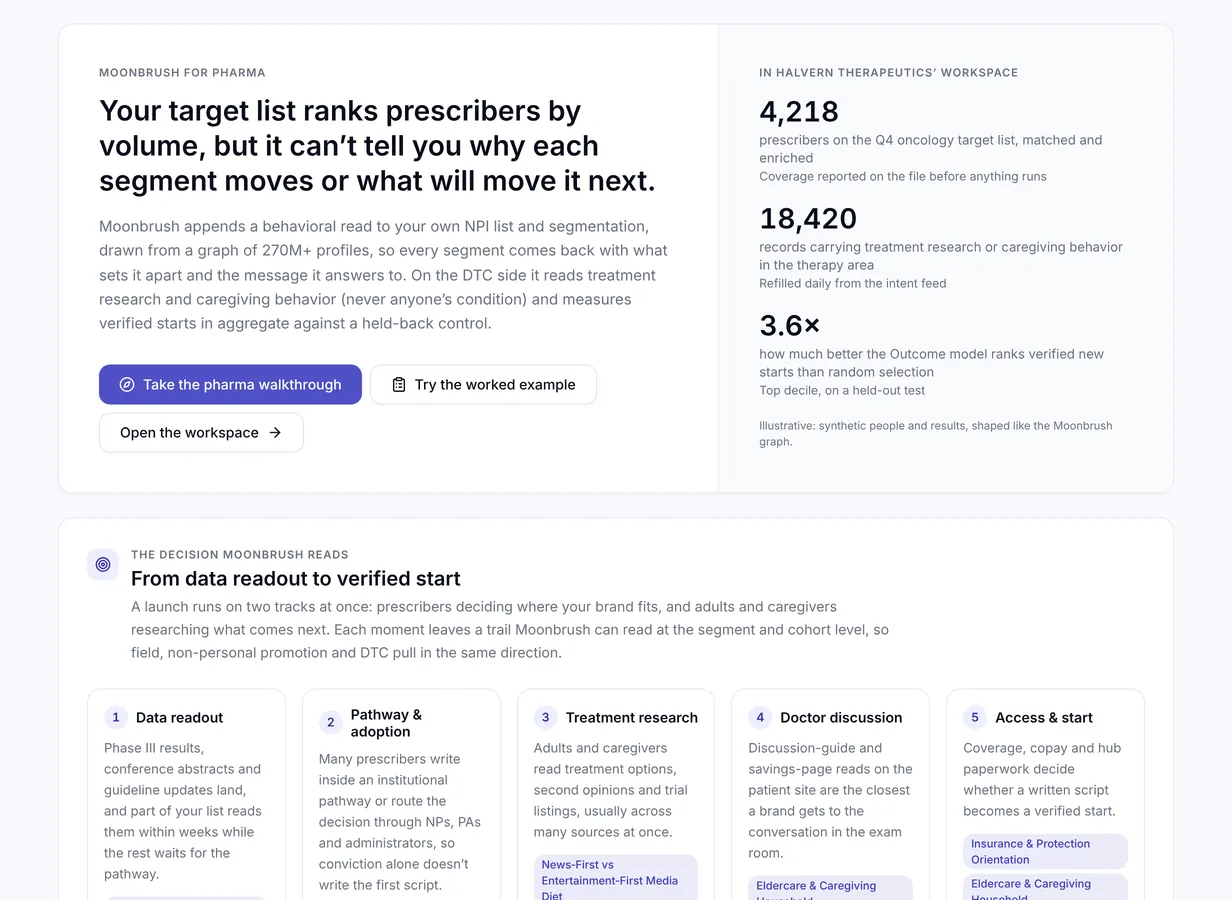
In the workspace.
Every decile gets a reasonPrescriber segments come back with why they move and the message each one answers to.
Demo workspace with synthetic people and results, shaped like the Moonbrush graph.
08Metrics
The numbers brand teams report upward
What brand, access and analytics leads take to the business review, and what a behavioral read changes about each.
-
NBRx
New-to-brand prescriptions, whether the patient is new to therapy or switching. The earliest read on whether a launch or a campaign is landing.
With MoonbrushYour target list comes back split by cohort with a holdout, so your own Rx data shows NBRx lift by cohort, not just by decile.
-
Abandonment
The share of new prescriptions that reach the pharmacy and are never picked up, usually over cost or a pending prior authorization.
With MoonbrushCoverage and copay research by patients and caregivers is read daily, so savings and hub support reach them before the first fill. Abandonment is then read in aggregate against a holdout.
-
Persistence
The share of patients still on therapy months after the start, tracked as days on therapy or time to discontinuation.
With MoonbrushMoonbrush never sees refills. Your hub data, read in aggregate, shows whether people reached with a motivation-matched message stay on therapy longer than the holdout.
-
Reach and frequency
How many target prescribers the field force and HCP media touched, and how often, measured against the call plan by decile.
With MoonbrushEach prescriber carries a decision style and a receptivity read, so frequency can shift toward the prescribers where another contact is likely to change something.
-
Promotional ROI
Incremental revenue per promotional dollar, by channel, usually from an annual marketing mix model.
With MoonbrushReads against a holdout give an in-flight incremental result by cohort and channel, a cleaner input to the mix model than attributed clicks.
09Proof
How you’ll know it worked.
What we measureNBRx in target segments and verified new starts, read against a holdout you choose.
Also in this market
The first 60 days
- Week 0
Agree on the decision, the data and the success criteria. Paperwork includes the data use agreement and the acceptance criteria.
- Weeks 1–2
Match keys and attach scores in the clean room or your warehouse. Your match rate is reported before anything is built.
- Weeks 3–8
Activate in your channels against a holdout you choose. Outcomes return as they happen.
- Day 60
Read-out on lift and impact, with the validation report. Then an annual program, if the numbers earn it.
10Questions
What brand teams ask us first
-
Can you find me patients with the condition?
No, by design: Moonbrush doesn’t target individuals by health condition or use claims, diagnoses or PHI. It reads treatment-option research, caregiving and coverage behavior, which shows who is deciding with no diagnosis in the model.
-
What happens when you match our NPI list?
We match it on NPI and return each prescriber with a decision style, a receptivity read and a message angle beside your existing tiers. You see the match rate before anything is built.
-
Will any of this get through MLR?
You get cohorts and message hypotheses ready for MLR review; claims and fair balance still come from your approved library. No cohort label implies a condition, so no condition reaches the creative brief.
-
How do I know it moved scripts, not clicks?
Every engagement starts as a 60-day proof against a holdout you choose. NBRx comes from your own Rx data, and verified hub starts come back hashed and are read only in aggregate.
11Rules
The rules that shape health marketing
What FDA, HIPAA, state health data laws and the FTC each change about targeting, and how Moonbrush works inside them.
FDA promotion rules and MLR
Under 21 CFR 202.1, drug ads need fair balance and the required risk information, and OPDP reviews DTC and HCP work alike. Moonbrush message hypotheses go through your MLR review like any other copy.
HIPAA
HIPAA governs PHI held by providers, plans, pharmacies and their business associates, and marketing with it generally takes the patient’s written authorization. Moonbrush ingests no PHI and, for standard services, isn’t a business associate.
State consumer health data laws
Washington’s My Health My Data Act and laws in Nevada and Connecticut require consent for consumer health data and restrict geofencing near care sites. Moonbrush excludes Washington and Nevada consumers from health-interest audiences.
FTC Act and Health Breach Notification Rule
The FTC has acted against health companies that passed health data to ad platforms without consent. Moonbrush offers no targeting by condition, and its client agreements bar targeting that exploits medical distress or recovery status.
The lines we don’t cross here
No health records, claims or PHI in any audience or model. We read research and caregiving behavior.
No cohort label implies a condition, and consumer health data follows our published notice.
Read the noticeEvery message hypothesis arrives ready for MLR review.
Scores guide marketing only, never coverage, eligibility or clinical decisions.