Financial services
Households decide to switch, borrow or re-shop long before they tell you.
Core systems know balances, products and tenure. Prescreened lists show who qualifies on paper. What they miss is the episode that opens a decision: a move, a remodel quote, a renewal worth re-shopping, a side business still banking as a consumer. Moonbrush reads those windows from 62.6B resolved behavioral events, refreshed daily.
The decisionWhere a household banks, borrows and insures, decided in the weeks around a life change.
01Pressures
What financial services marketers are up against
Rate-sensitive deposits move fast, balances leave without an account closing, and policyholders shop at renewal.
-
Rate-sensitive money moves first
Hot money goes to whoever reprices first, and promo balances leave when the teaser ends. The balances that stay come from primary relationships.
-
Primacy leaks before accounts close
Customers keep the checking account and move the money: savings to an online bank, investments to a brokerage, pay to an app. By the time the account closes, the relationship is long gone.
20%
Of retail bank customers moved money away from their primary bank in the past three months, up from 17% a year earlier.Source: J.D. Power, 2026 U.S. Retail Banking Satisfaction Study, March 2026. 107,059 retail bank customers, fielded January 2025 through January 2026. -
Renewals have become shopping trips
After years of premium increases, policyholders pull quotes from apps and comparison sites in minutes. Retention is decided while they compare, usually before anyone at the carrier notices.
3.5
Quotes collected on average by auto insurance shoppers, the most in the study’s history.Source: J.D. Power, 2026 U.S. Insurance Shopping Study, June 2026. 12,437 insurance customers, fielded January 2025 through January 2026.
02Blind spot
Your systems see the account. Not the life around it.
What your data shows
Core banking
Balances, products and tenure.
Prescreened lists
Who qualifies on paper.
Digital banking
Logins, clicks and abandoned applications.
What it can’t show
The episode that opens a decision
A move, a remodel, a new job, a renewal coming due.
Shopping elsewhere
The rate comparisons that come before a switch.
The reason that fits
Why this household would choose you, in its own terms.
What Moonbrush adds
atlas resolves your customer file to individuals and households, reads the episodes around it daily, and delivers audiences and scores to the warehouse, CRM and channels you already run. Results are counted from your own systems.
03Decision
A money decision, start to finish
Most primary relationships change inside a narrow window. This is where it opens and where it closes.
-
01
A life episode
A move, a new job, a remodel, a first child, side income.
We read
Moving, home-improvement and career research.
You can
Know the window is open.
-
02
Comparing
Rates, reviews and calculators, quietly.
We read
Rate-shopping and comparison behavior.
You can
Reach them with the reason that fits.
-
03
The switch window
The direct deposit, the mortgage or the policy is up for grabs.
We read
The timing of each household’s episode.
You can
Land the offer inside the window.
-
04
The decision
An account opened, a loan funded, a policy bound.
We read
Funded accounts, loans and binds from your own systems.
You can
Count the result from your records, not clicks.
-
05
Staying primary
Products per household, balances and tenure.
We read
Signs of re-shopping inside your own base.
You can
Make the retention offer before the switch, not after.
04Calendar
When money decisions cluster in the year
Money decisions follow the tax calendar, the housing market and benefits season, so the windows are predictable even when the households aren’t.
January to April
Tax season
Refunds land, mostly in February and March, and prior-year IRA and HSA contributions run to the April filing deadline. Households decide where the refund sits and where retirement money goes.
With MoonbrushFind households researching tax prep, IRAs and paying down debt, and time deposit and IRA offers to the weeks refunds arrive.
March to June
Spring home season
Purchase mortgages, remodel projects and home equity lines concentrate as buyers and owners plan the summer. The lender is often chosen before the first application.
With MoonbrushRead home-shopping and contractor-pricing behavior on prospects and your own customers, and reach owners with a home equity offer while the project is still being priced.
May to September
Moving season
Moves peak in summer, ahead of the school year. A new address reopens the bank, the branch, and the auto and home policies.
With MoonbrushA daily new-mover feed inside your footprint, with the reason that fits each household, while the direct deposit and the policy are still up for grabs.
September to November
Budget season
Next year’s acquisition targets, channel mix and test budgets get set, mostly on last year’s results.
With MoonbrushStart a 60-day proof in late summer so the holdout read is in hand before the plan locks.
October to December
Open enrollment
Most employers run benefits elections in the fall, and Medicare’s annual enrollment runs October 15 to December 7. HSAs, voluntary life and disability cover get chosen in a few weeks.
With MoonbrushFind employees weighing HSAs and supplemental life, and people nearing retirement, and reach them inside the election window with the reason that fits.
November to December
Year-end planning
Most required minimum distributions, tax-loss harvesting, charitable gifts and final 401(k) deferrals close on December 31. Households and advisors settle where money sits for the next year.
With MoonbrushScore clients and prospects for year-end moves, such as a rollover after a job change, and route them to advisors before the deadline.
05Cohorts
Same balance, same tenure. Three different reasons to move.
Three households that look alike in your core system are living through three different episodes.
-
New movers
Just moved into your footprint.
- What holds them back
- Their old bank still has the direct deposit.
- What they answer to
- A branch nearby, and switching done for them.
-
Side-business starters
Earning from work of their own, banking as a consumer.
- What holds them back
- Don’t think of themselves as a business yet.
- What they answer to
- Business banking that starts small.
-
Renewal re-shoppers
A rate or a policy is coming due.
- What holds them back
- Inertia, until a better quote appears.
- What they answer to
- Your best offer, before the renewal notice.
Illustrative cohorts, shaped like the splits we return.
06Lessons
What we’ve learned in this market.
-
Relationships change in windows.
Outside a life event, the incumbent’s inertia usually wins. Inside one, a household is open to a new bank, lender or carrier for a few weeks. Knowing when the window opens matters more than how long the list is.
-
Your next business customers already bank with you.
Consumers who have started paid work of their own still look like consumers in your core system. Their behavior shows the business months before the first invoice.
-
Compliance is the design brief.
Marketing audiences have to stay clear of credit, underwriting and rating decisions, and every list has to clear fair-lending review. We build to those lines from the start, not after.
07Plays
Three places to prove it first.
Each is scoped to one decision, measured against a holdout you choose and read out on day 60.
Usually through
-
Win primary checking from new movers
Pick up households moving into your footprint from a daily feed, while the direct deposit is still up for grabs.
What you getA daily new-mover audience inside your footprint, with the reason that fits each household.
-
See the business inside your base
Spot consumer customers who have started paid work of their own, and offer business banking before the first invoice.
What you getA scored list of consumer customers with business behavior, returned to your CRM.
-
Catch switching before it happens
Flag the comparison and rate-shopping behavior that precedes a switch, and reach the customer while there’s still a decision to influence.
What you getRe-shopping signals on your own customers, refreshed daily.
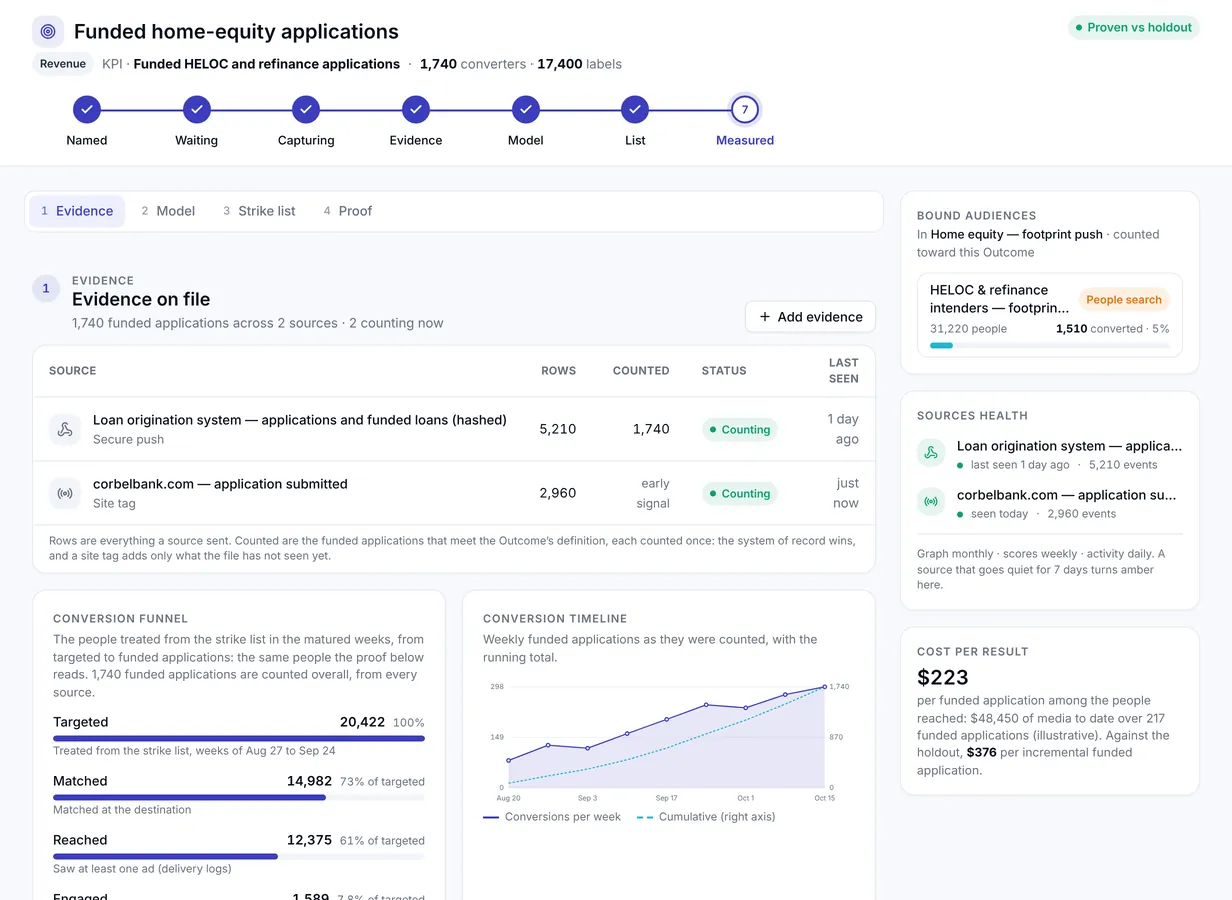
In the workspace.
Counted from your recordsFunded accounts, loans and binds come from your own systems and are read against a holdout.
Demo workspace with synthetic people and results, shaped like the Moonbrush graph.
08Metrics
The numbers a bank, lender or carrier reports upward
Named the way finance and the board read them, with what Moonbrush changes about each.
-
Primacy
Share of checking households where you hold the direct deposit and the everyday debit spend, not just an open account.
With MoonbrushScores new movers and job changers while the direct deposit is still being decided, and flags customers who are shopping other banks. Results are read against a holdout.
-
Cost per funded account
All-in acquisition spend divided by funded accounts and loans, not applications or opens.
With MoonbrushMoves spend toward households inside an open window, and decision style helps separate a would-be primary customer from a bonus hunter. Funded counts come from your core.
-
Deposit attrition
Balances and households lost, including soft attrition: money moving out while the account stays open.
With MoonbrushRe-shopping signals on your own customers, refreshed daily, so a retention offer can go out while the money is still there. Retained balances are read against a holdout.
-
Products per household
How many of your products each household holds, the shorthand for depth and for how hard the relationship is to leave.
With MoonbrushScores your own customers for the next product their behavior points to, such as a business account, a home equity line or an IRA, and when to offer it.
-
Quote-to-bind
Share of quotes that become bound policies. With retention, it’s the number every personal lines marketer answers for.
With MoonbrushTimes outreach to the weeks a household is shopping, and splits shoppers by what moves them: price, coverage or service. Binds are counted from your policy system.
09Proof
How you’ll know it worked.
What we measureNew primary households, products per household and retained balances, read against a holdout you choose.
The first 60 days
- Week 0
Agree on the decision, the data and the success criteria. Paperwork includes the data use agreement and the acceptance criteria.
- Weeks 1–2
Match keys and attach scores in the clean room or your warehouse. Your match rate is reported before anything is built.
- Weeks 3–8
Activate in your channels against a holdout you choose. Outcomes return as they happen.
- Day 60
Read-out on lift and impact, with the validation report. Then an annual program, if the numbers earn it.
10Questions
What banks, lenders and carriers ask us first
-
Is any of this a consumer report? If it touches FCRA, compliance stops it.
Moonbrush scores decide who hears from you, when and with which message. They never feed credit, underwriting, rating or eligibility decisions, and your prescreen and firm-offer process stays with your bureau.
-
What leaves our walls? Vendor risk and our GLBA people will ask before anyone else.
atlas works in your warehouse, CRM or clean room, and only hashed keys cross. Your data stays in your own instance, is never pooled with another client’s and never trains models shared with other clients.
-
We already buy new-mover files and prescreened lists. What’s different?
Those tell you who moved or who qualifies on paper. Moonbrush adds when a household’s window opens, why it would choose you, and which of your own customers are already shopping elsewhere.
-
How do we know it’s incremental, and not people who would have opened anyway?
Every engagement starts as a 60-day proof on your own data, against a holdout you choose. Funded accounts, funded loans and bound policies are counted from your own systems, not from clicks.
11Rules
The rules that shape financial services marketing
Financial marketing answers to credit, privacy and insurance law at once, and each one limits who you can target and how.
FCRA, prescreens and trigger leads
Bureau data can pick recipients only for a firm offer, and since March 2026 mortgage trigger leads need consent or an existing relationship. Moonbrush scores set reach, timing and message, never eligibility.
ECOA, Reg B and fair lending
Reg B bars marketing that discourages applicants on a prohibited basis; Meta’s financial products category drops lookalikes and ZIP, age and gender targeting. Modeled ethnicity is never selectable, and lists go through your fair-lending review.
GLBA privacy
GLBA generally lets you share customer data with an outside firm only after notice and opt-out, or under service-provider terms. Only hashed keys cross; your data stays in your own instance, never pooled.
Insurance unfair discrimination rules
The NAIC’s AI bulletin and Colorado’s SB21-169 reach insurer marketing, not just rating, and make insurers answer for data vendors. Scores never feed rating or underwriting, and modeled ethnicity is never selectable.
The lines we don’t cross here
Moonbrush scores never feed credit, underwriting, rating or eligibility decisions.
Every list still clears your fair-lending and special ad category review.
Modeled ethnicity is never selectable, and only hashed keys cross the match boundary.